THE IDENTITY CORE FOR AI

Your vibes,
codified.

Your personality, taste, voice, values, purpose, and aesthetic. Written down for your AI, with the context it needs for your life, work, and brands.

Dashboard
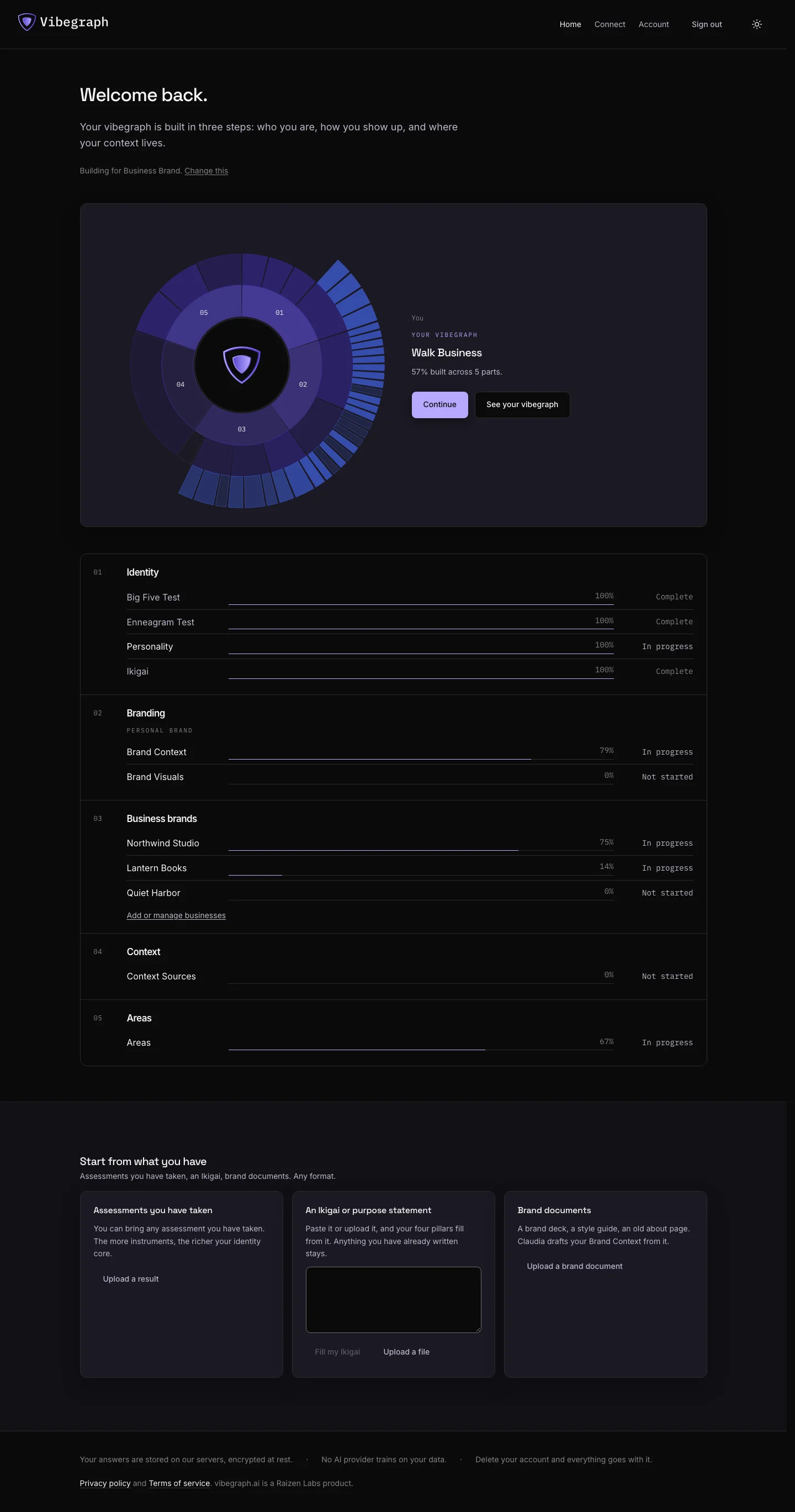
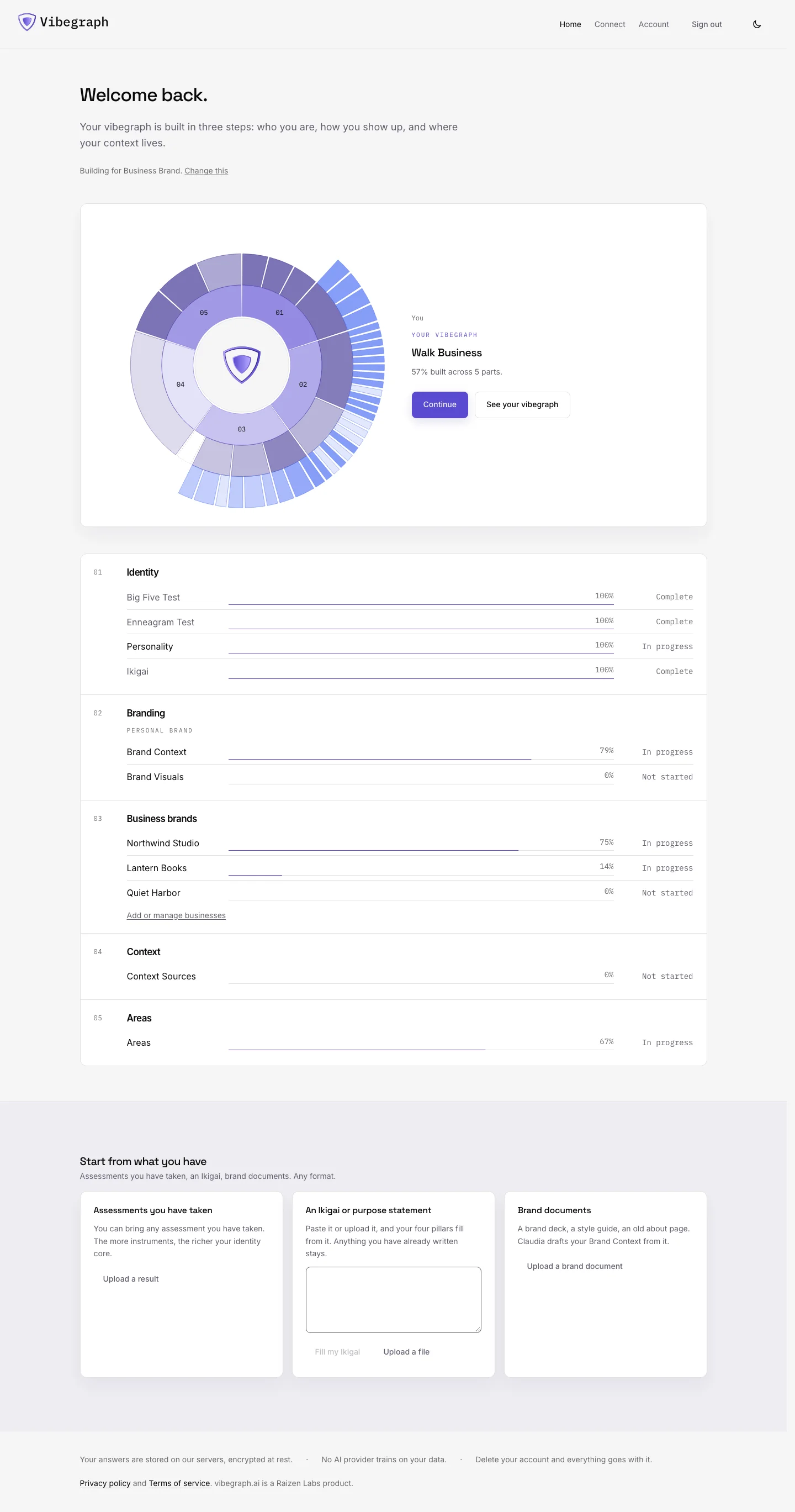
The app dashboard with the identity graph and nested business brands.The app dashboard with the identity graph and nested business brands.

WEEKLY NEWSLETTER

The Context Layer

Get weekly breakdowns of the systems solo founders and small business owners use to turn identity files, agent memory, and context layers into revenue.

Read the latest issue

WHAT YOU BUILD HERE

Train your AI to mimic your vibes.

Who you are.

Your Core Identity is free: the Big Five and Enneagram assessments, an integrated reading, and your Ikigai with Claudia, the in-app AI assistant. Bring assessment results you already have, too. Choose the areas of life and work your AI should know about.

How you work and sound.

Personal Use gives you seven elements of personal context. Personal Brand expands them to twelve elements in words and eight in visuals. Make the visuals in your own design tool with the builder's prompts, then record the results and asset locations.

What your business stands for.

Build brands for the businesses you own or operate. Each stays nested under you, with its own foundations, 12 written elements, and 8 visuals. Personality assessments are optional on the business path.

HOW IT WORKS

Define once. Bring it with you.

The guided builder writes the center of your vibegraph with you. The open framework gives it a shape your tools can read.

  1. Choose what you need.

    Personal Use for your life and work. Personal Brand for how you show up online and in public. Business Brand for the businesses you own or operate. Start from scratch or bring what you have. Claudia helps you work through the questions.

  2. Make it readable.

    Export VIBEGRAPH.md with your identity and completed brand files, Context Sources, and only the areas you chose. The folder includes instructions that point agents to the root file first, plus a paste bundle for chats.

  3. Bring it to your tools.

    Use the exported files in a project or paste their content into a chat. Connect is an optional $9 monthly subscription for supported tools to read the hosted center and map live, with grants for Claude, Codex, Cursor or whatever AI agent you use, with a log of every served read.

Start from where you stand.

Starting from scratch?

Choose the path that fits what you need. You can build personal context without a personal brand, or start a business brand without taking personality assessments. Claudia asks the questions, you decide what the finished words should say.

Already have pieces?

Bring assessment results, an Ikigai, brand documents, or notes you have already written. The builder helps you use that material and fill the gaps. You can write directly or work through the guided questions.

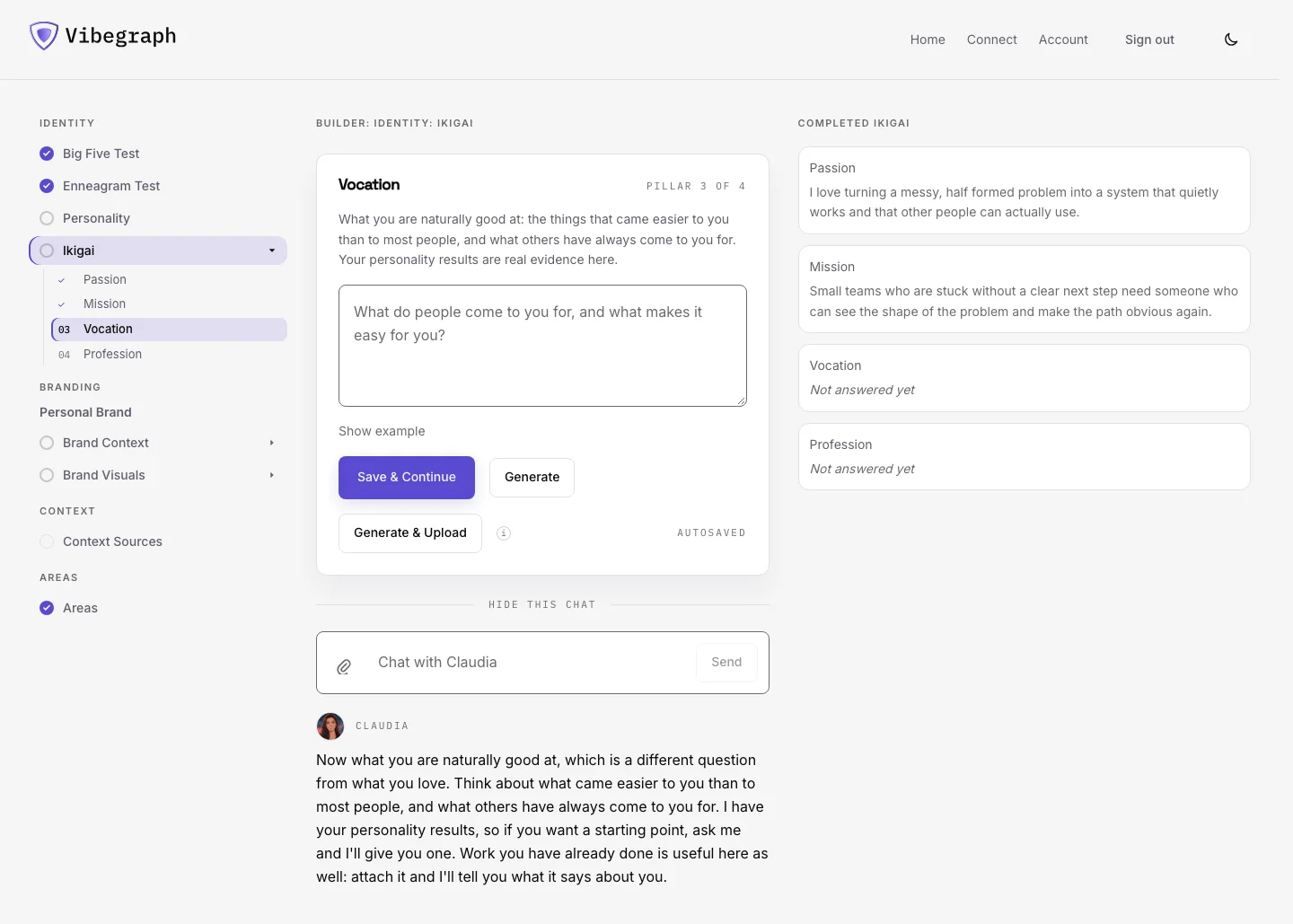
Ikigai
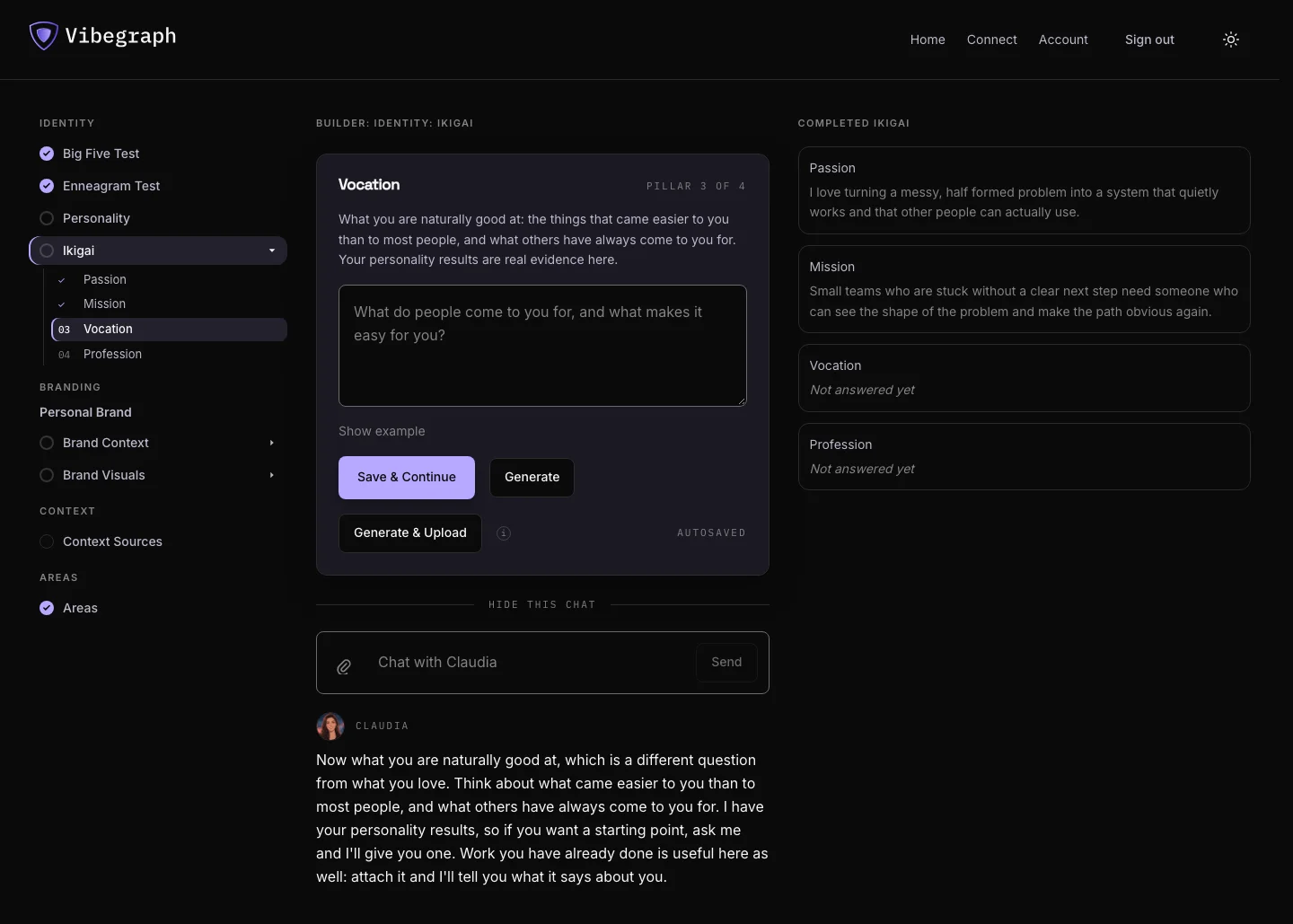
The Ikigai builder with a guided question, completed answers and Claudia.The Ikigai builder with a guided question, completed answers and Claudia.

Your visuals, made in the tool you already use.

Finish your Brand Context, then take your partial vibegraph, 8 prompts, and a brief into your design tool, such as Figma or Claude Design. Make the visuals there, record the 8 elements in the builder, and tell it where the assets live. Your export includes the recorded values and asset locations. The builder does not generate logos or imagery.

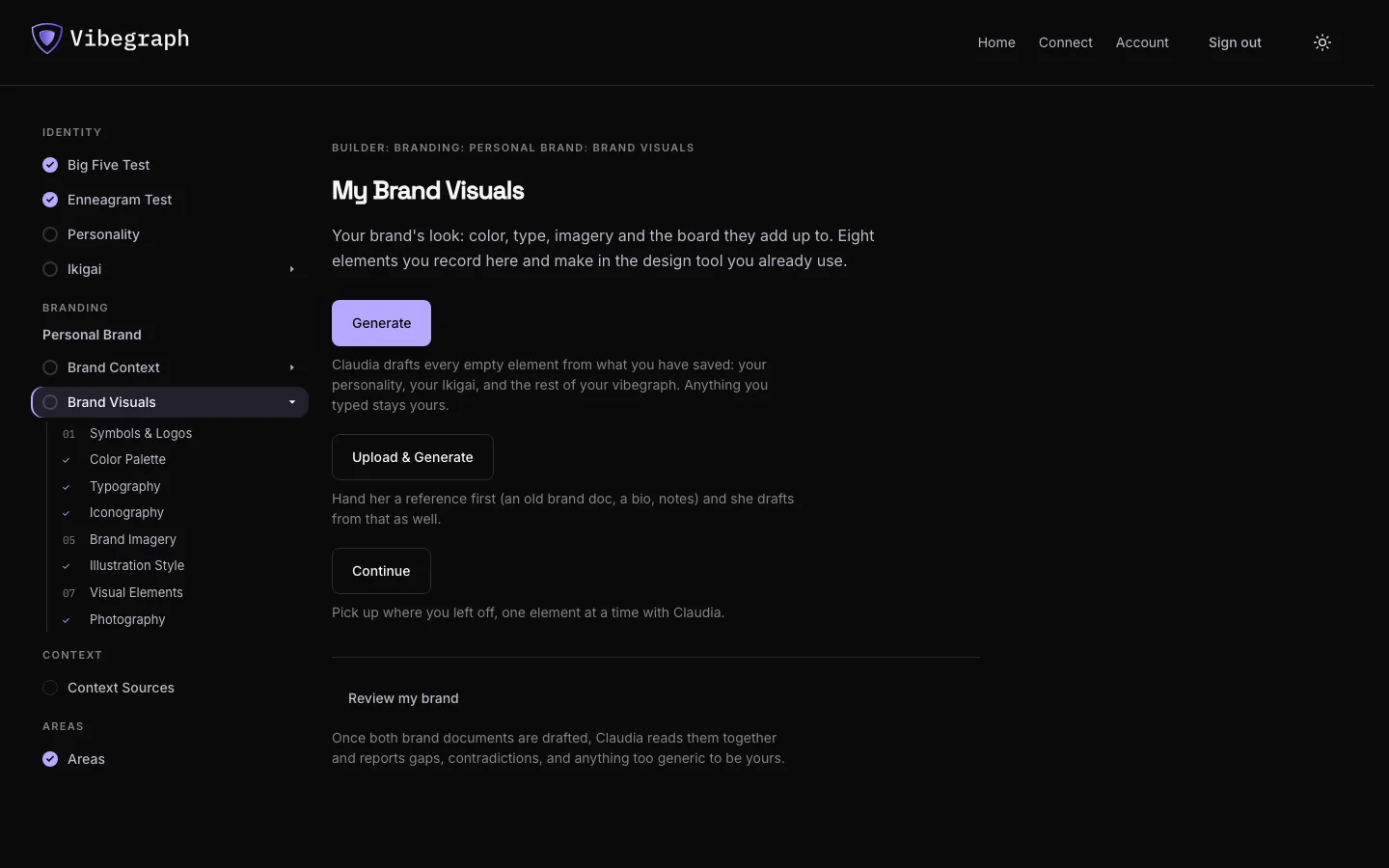
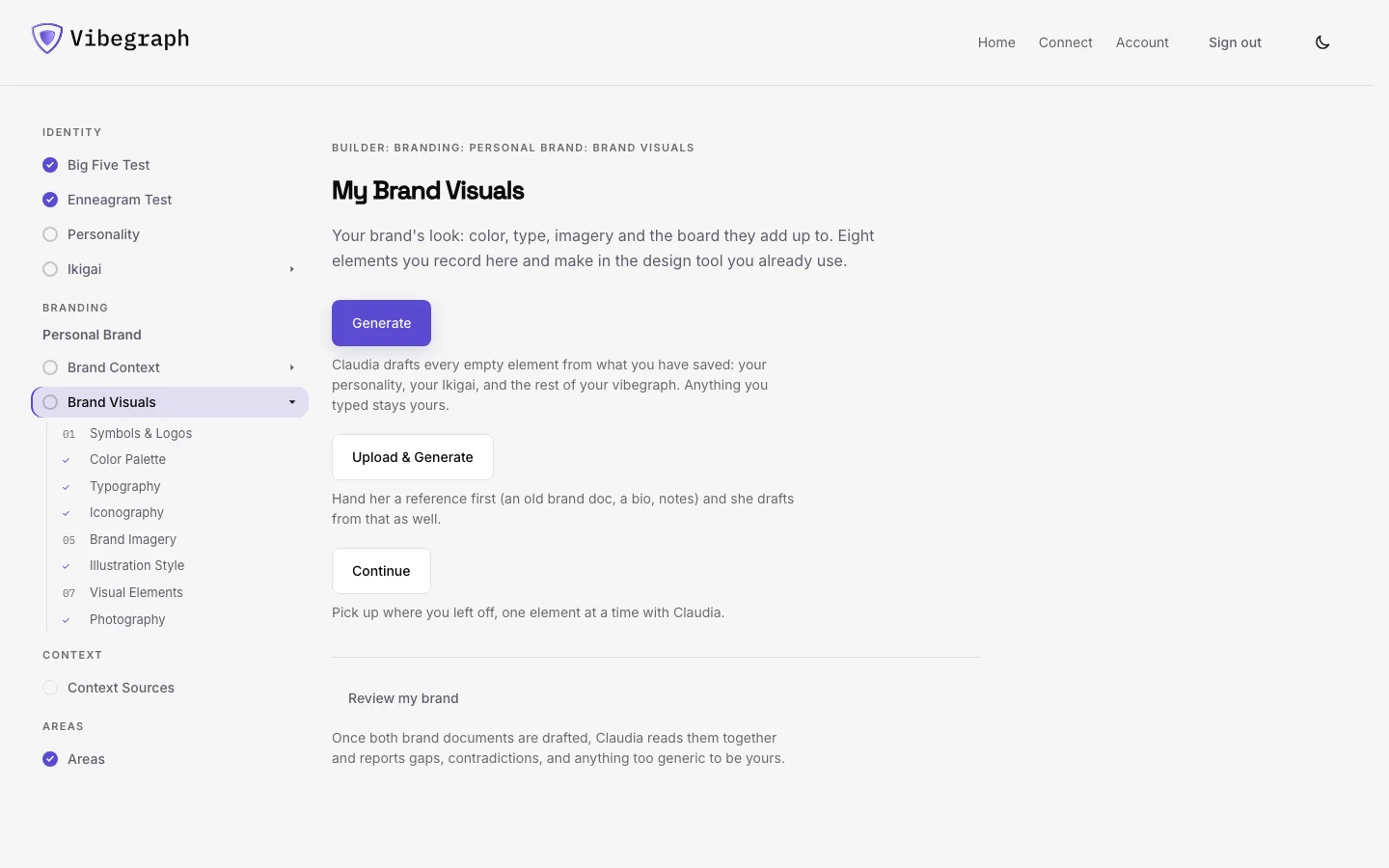
Brand Visuals
The Brand Visuals screen listing the eight visual identity elements.The Brand Visuals screen listing the eight visual identity elements.

WHERE EVERYTHING ELSE FITS

Your identity is the center. The ecosystem is bigger.

Register the systems you already use as Context Sources. Pick one to see where it fits.

Notes, Knowledge layerReference, Knowledge layerReferenceWorkspace, Knowledge layerConversations, Memory layerEvents, Memory layerEventsHistory, Memory layerInstructions, Agents layerSkills, Agents layerSkillsTasks, Agents layerCadence, Agents layerCadenceInward, Clones layerOutward, Clones layer

These are examples of where tools fit. Registering a tool does not connect it or import its contents. None is required.

START WITH IDENTITY

Who you are.

A vibegraph is the network of identity, context, knowledge, and memory that governs how AI thinks, writes, and acts for one person, and any businesses they own or operate.

TWO SIBLINGS, ONE FOUNDATION

Identity, then expression.

vibegraph.aivibegraph.ai

Define your identity.

The guided builder for the center of your vibegraph.

Start building
vibeclone.aivibeclone.ai

Put it to work.

A vibeclone is your vibegraph pointed inward as an agent that works for you, or outward as a clone that speaks for you.

Learn more
Prefer to start with the format?Explore vibegraph.md

A LITTLE MORE CONTEXT

Good questions.

How does this fit with the notes and tools I already use?

Your notes, memories, and projects can stay where they are. Register their systems as Context Sources, then use areas to organize pointers by subject. Your vibegraph tells a capable tool who you are and where to look. It does not copy every source into the builder.

How is this different from ChatGPT's or Claude's memory?

A vibegraph is context you write, review, and can export as files. You choose the statement of who you are and how your brands should sound. Memory can build on that statement as you work. Registering a memory system does not automatically update it.

What is VIBEGRAPH.md?

The root file. It names the person, links the parts of the graph, and tells an agent what to read and when. The open specification at vibegraph.md defines its format. Give the files to a tool that can read them, use a paste bundle, or add Connect for supported tools to read the hosted content live.

Do I have to take your assessments?

You can bring assessment results you already have. The built-in Big Five and Enneagram assessments, your integrated reading, and your Ikigai are included in the free Core Identity. Personality assessments are optional on the business path. The business still stays anchored to you as a person.

What if I do not need a personal brand?

Choose Personal Use. It gives you seven elements of personal context, Context Sources, and export. Your Core Identity and areas are free. If you later want a full personal brand, upgrade by paying the difference and keep the work you have already done.

Do you generate my logo and visuals?

The builder writes your Brand Context and prepares a brief and eight prompts. You make the visuals in your design tool, then record the results and asset locations in the builder. Brand Visuals are included with Personal Brand and business brands.

Can I build more than one business brand?

Yes. Personal + 1 Business includes one business brand. Each additional business is a $49 one-time purchase before any applicable launch discount. Each has its own foundations and brand files, nested under you. You can be the owner, a staff member, or an agency operator. Team sharing is not included.

What does Connect do?

Connect lets supported AI tools read your hosted vibegraph live, with grants for each connected tool and a log of every served read. It costs $9 a month on any tier, including free. Cancel any time; your grants are kept if you return. Connect does not unlock a higher build tier.

If I connect Claude over MCP, can it read my notes or resume?

Connect serves the center and map you have built in vibegraph.ai, subject to that tool's grants. An area's entry can tell it where notes or a resume live. That pointer does not give Claude access to your computer, notes account, or another service. The tool needs its own way to reach that source and your permission to use it.

Who can see my vibegraph?

You can access your account's content. The hosted builder's operator and systems can also read stored content: it is encrypted in transit and at rest and scoped to your account, but it is not zero-knowledge storage. AI features send the content they need to providers under a no-train policy. Connected tools receive the public, always-read core and any further content you grant to that tool. You can instead use the open framework as local files on hardware you control.

What does it cost?

Core Identity is free. The one-time list prices are $19 for Personal Use, $79 for Personal Brand, and $149 for Personal + 1 Business. Each additional business is $49. Upgrades cost the difference. Connect is an optional $9 monthly subscription on any tier. Launch discounts apply to eligible one-time purchases; the pricing page explains the offer and the app shows what you will pay.

Is the framework free to use?

Yes. You can make a vibegraph by hand from the open specification. Templates, schema, and code use the MIT license; prose uses CC-BY 4.0. The word vibegraph is a lowercase common noun. vibegraph.ai is one builder for it.